
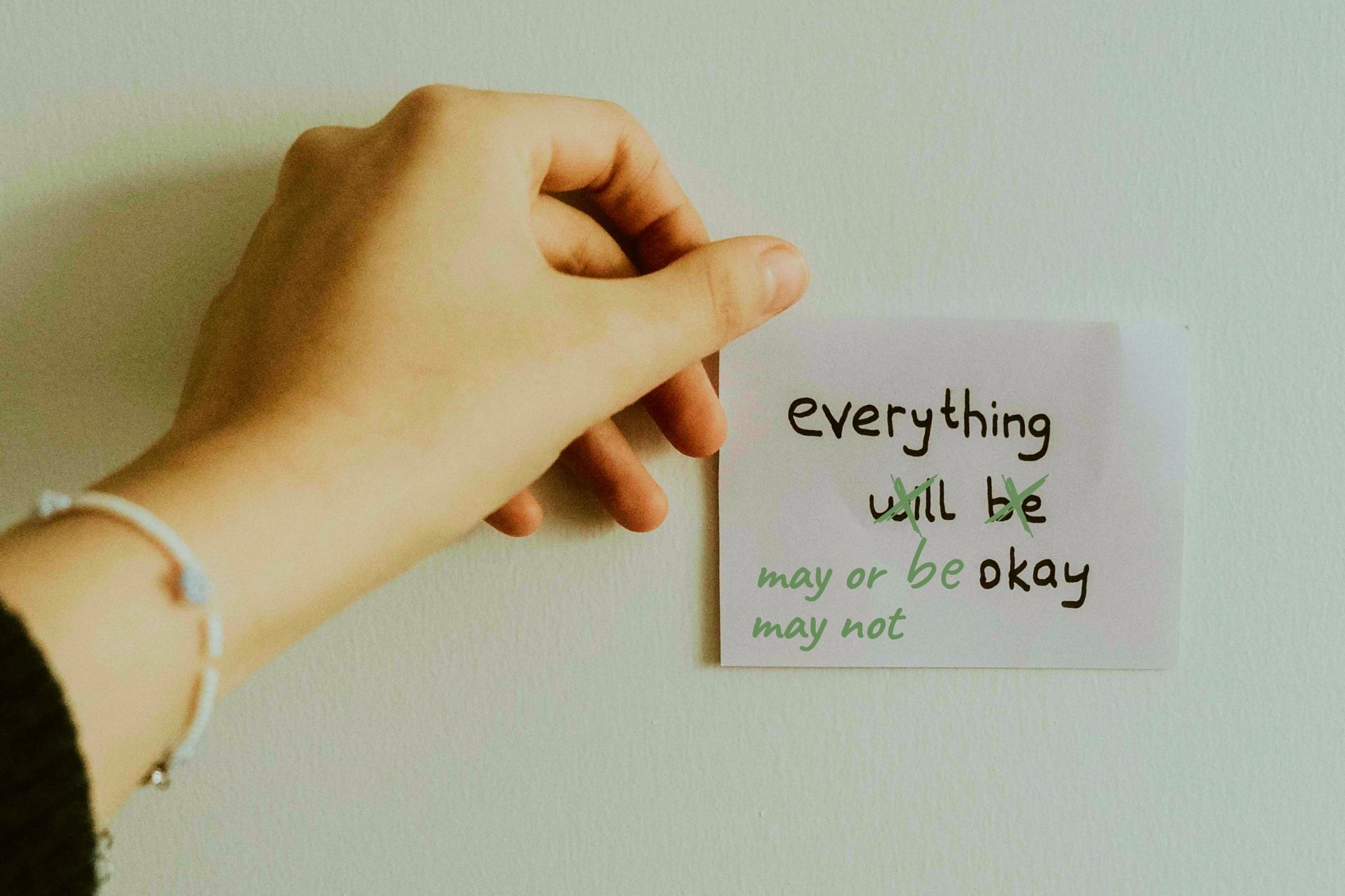
What are intrusive thoughts, and why can’t I make them stop?
The word “intrusive” actually tells you everything.
Let’s start with the word itself. Intrusive literally means something that is unwanted or uninvited. It’s the thought that pops in and makes us go, “AH!” – the one that seems to come out of nowhere, that we were not looking for, and did not ask for.
That’s it. That’s an intrusive thought.
And here’s the thing that might surprise you: most of us have them.
Why do people have intrusive thoughts?
To be honest? I think that most of us have intrusive thoughts.
A really common example: “What if I fell onto the train tracks right now?” or “What would I do if the plane were to crash?”
The difference is that some people have a thought like that and think, “that was weird,” and then they move on. They don’t then Google it for three hours.
Whereas someone dealing with Obsessive Compulsive Disorder (OCD), or someone in a high-anxiety state, might be extremely distressed by the exact same thought. They might feel they need to get rid of it, counteract it, explain it, or neutralize it somehow.
And that’s where the loop begins.
Why do they feel so real and so distressing?
Intrusive thoughts are real in a sense because we are actually thinking the thought.
But it’s the meaning we assign to them that makes them distressing, and makes them feel more real than they are.
The thought itself is just a thought. And the distress comes when we give the thought meaning.
For example: “Having this thought must mean that I am a bad person.”
You’ve just assigned an analysis to the thought. You’ve turned a momentary mental blip into a verdict about your character. And now you’re not just dealing with a weird thought, you’re dealing with a belief about who you are.
That is where the real suffering lives, in the story that is built around the thought.
The biggest misunderstanding about intrusive thoughts:
People think that they can shake their heads like an Etch-A-Sketch toy, and the thoughts will disappear.
They think that they can:
- Reassure the thoughts away
- Logic them away
- Research them away
- Soothe them away
- Or, let’s be honest, drink or smoke them away
None of it works in the long run.
The only true way to deal with intrusive thoughts is to not deal with them. Which sounds almost too simple, but is actually one of the hardest things a person can do when they’re in an active trigger moment. Because every instinct screams at you to do something.
What Does the OCD Loop Actually Look Like?
There are many subtypes of OCD
- moral scrupulosity,
- contamination,
- relationship OCD,
- harm OCD,
- somatic OCD
But regardless of where your thoughts focus, the loop is usually the same:
Trigger → Obsession → Compulsion → Temporary relief → Back to the beginning
The compulsion is an attempt to escape fear. But what it actually does is to feed it. Every time you perform the compulsion, you send your brain a signal: this threat was real enough to respond to. And the brain takes note.
Think of it like getting used to cold water. If you just stay in, you habituate to the temperature. The cold becomes manageable. But if you keep jumping out and getting back in, you never adapt. The cold stays present, or in this case, the fear.
So what actually helps?
The gold standard treatment for intrusive thoughts and OCD is ERP, which stands for, Exposure and Response Prevention. You learn to sit with the trigger (exposure) without feeding the compulsion (response prevention). Over time, the thought loses its intensity.
This is not easy work. But it is incredibly effective, and it is possible.
You don’t have to white-knuckle this alone.
If you recognize yourself in any of this, if you’re exhausted from fighting thoughts that keep coming back no matter what you try, take a deep breath with me. You’re human, you’re in the right place, and you’re dealing with something that has a name, and a path through it.
I am so glad that you are here!
→ Book a free 30-minute discovery call
Amalia Sirica, LCSW, is a licensed therapist with 10+ years of experience working with OCD, anxiety, trauma, and neurodivergent clients. She believes that healing should feel human, never clinical and cold.
0 Comments