

Is your brain a browser with 300 tabs open, one of which is playing an awful song on a loop you just can’t find? That’s what managing intrusive thoughts as a neurodivergent person with OCD can feel like. The key is realizing you don’t have to close every tab or stop the music to get on with your day. Effective management isn’t about eliminating thoughts; it’s about changing your relationship with them, so they no longer hold you hostage. By learning to acknowledge, reframe, and redirect, you can reclaim your focus and reduce the distress these thoughts cause, creating space for what truly matters.
This guide will walk you through a series of concrete steps to build this new relationship with your thoughts. Before we begin, it’s helpful to have a basic understanding of what we’re working with.
Prerequisites:
- A notebook and pen, or a digital notes app.
- A willingness to be uncomfortable. Change rarely happens in your comfort zone.
- An understanding that this is a process. You won’t master it overnight, but you will make progress.

The Overlap Between Neurodivergence and OCD
First, let’s clear up a common misconception. Having intrusive thoughts doesn’t automatically mean you have OCD. Most people have occasional weird, unwanted thoughts. The difference is that for neurotypical people, these thoughts are like spam email: easily ignored and deleted. For someone with OCD, especially a neurodivergent person (with ADHD or Autism), that spam email has a flashing neon sign that says “URGENT! OPEN NOW!”
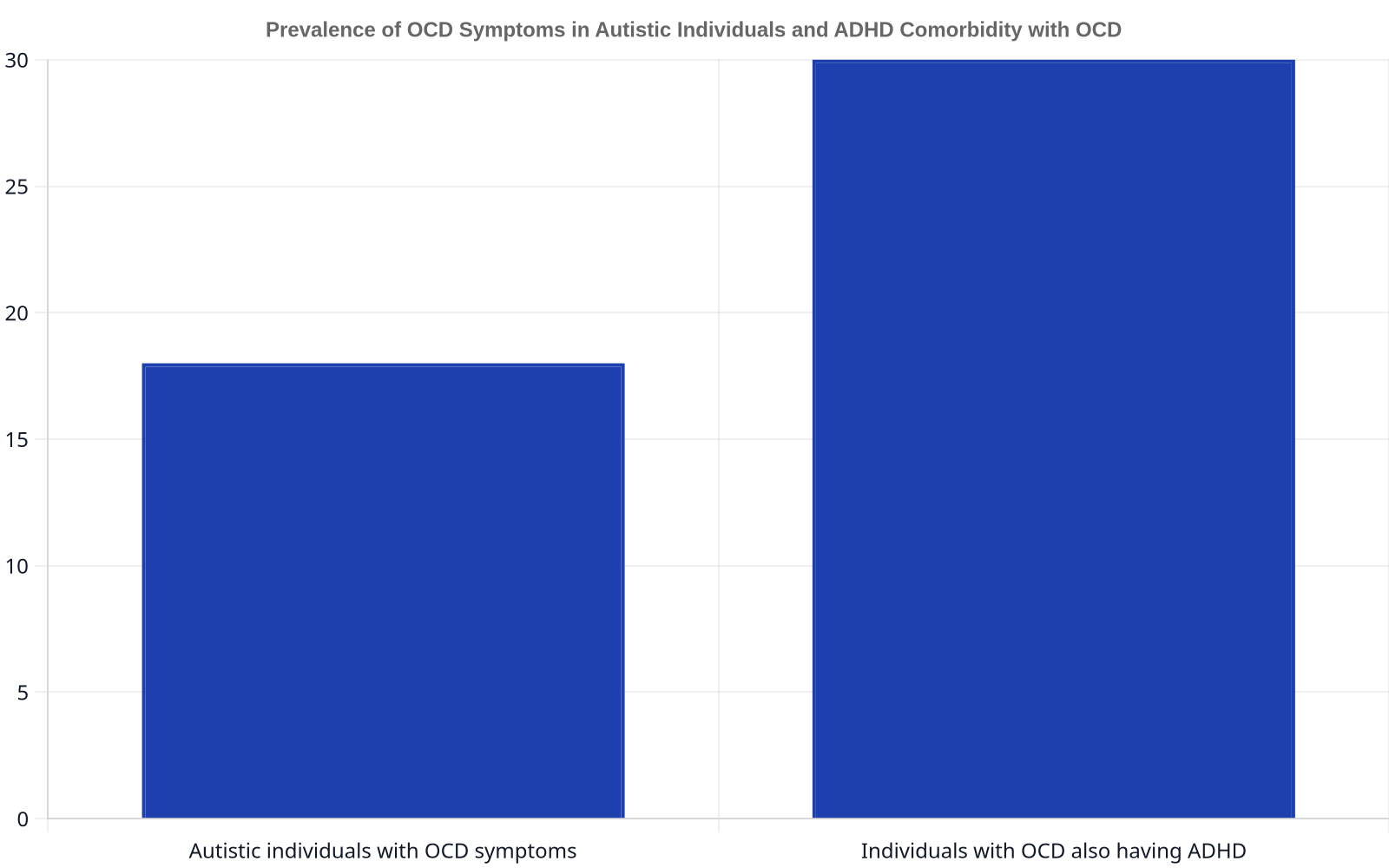
The connection isn’t just anecdotal. Research shows a significant overlap. For instance, some studies find that 11–25% of autistic individuals experience obsessive–compulsive symptoms. Similarly, the link between ADHD and OCD is well-documented, with some sources suggesting that up to 30% of individuals with OCD may also meet the criteria for ADHD. It’s a complex Venn diagram where executive function challenges, sensory sensitivities, and emotional dysregulation can create a perfect storm.
The way we process information, notice patterns, and hold onto thoughts can be intense, layered, and sometimes exhausting.
Tim Aiello, MA, LPC, NCC, ADHD-CCSP, ASDCS | Clinical Director | Myndset Therapeutics (myndset-therapeutics.com)
This isn’t a personal failing; it’s a matter of brain wiring. Your brain might be more prone to getting “stuck” on a thought, a trait that can be a superpower when you’re hyperfocused on a special interest but a serious problem when the focus is a distressing intrusive thought.
Understanding the Scope of OCD in the U.S.

If you’re struggling, you are far from alone. Obsessive-Compulsive Disorder is a significant mental health challenge affecting a large portion of the population. According to the International OCD Foundation, nearly 2.5 million Americans struggle with obsessive-compulsive disorder (OCD). Other estimates are even higher, suggesting more than 8 million U.S. adults live with the condition. These numbers highlight the widespread nature of OCD and the urgent need for effective, accessible strategies and support, especially for the neurodivergent community, where these challenges are often compounded.
How to Manage Intrusive Thoughts: Step-by-Step
Now, let’s move from understanding to action. These steps are designed to be practiced, not perfected. They build on each other to form a comprehensive strategy for managing intrusive thoughts.
1. Identify and Name the Thought
Your first task is to become an observer of your thoughts, not a participant in them. When an intrusive thought arises, your instinct is to either fight it or fuse with it. We’re going to do neither.
Instead, you will label it. Say to yourself, “I am having an intrusive thought that [describe the thought].” Or even more simply, “Ah, an intrusive thought.” This creates a small but crucial bit of separation. It reframes the experience from “I am a person who wants to do this terrible thing” to “My brain has generated an unwanted thought about this terrible thing.”
Verifiable Outcome: You can catch an intrusive thought as it happens and label it internally without immediately reacting to it.

2. Acknowledge, Don’t Argue
Once you’ve labeled the thought, the next step is to acknowledge its presence without engaging in a debate. Your brain wants to argue. It wants you to prove the thought is wrong, to reassure yourself, to perform a mental check. This is a compulsion, and it’s the fuel that keeps the OCD engine running. Your job is to cut the fuel line.
Acknowledgment sounds like: “I see you, thought about harming someone. Thanks for sharing, brain.” It sounds absurd, but this disarms the thought. You are treating it with a kind of detached indifference. You’re not agreeing with it, but you’re not fighting it either. You are simply allowing it to be there, like a cloud passing in the sky.
Verifiable Outcome: You can sit with the discomfort of an intrusive thought for at least 30 seconds without trying to neutralize it with a compulsion (like reassurance-seeking or mental review).
3. Practice Mindful “Floating”
Mindfulness is often misunderstood as clearing your mind. That’s not it at all. It’s about letting your thoughts come and go without getting swept away by them. Dr. Claire Weekes, a pioneer in anxiety treatment, called this “floating.”
Imagine you are a buoy in the ocean. The intrusive thoughts are waves. Some are small ripples; others are huge, crashing swells. Your job isn’t to stop the waves. Your job is to just float. You rise with the wave of anxiety and fall with it, but you don’t get dragged under. You notice the wave, feel the feeling it creates in your body (a knot in your stomach, a racing heart), and you let it pass without tensing up and resisting. Resistance is what creates the struggle.
Verifiable Outcome: You can identify the physical sensations anxiety creates in your body and breathe through them without letting them trigger a compulsive behavior.
An intrusive thought is like a heckler in a comedy club. The more you engage with it, the more you empower it. The real power move is to just let it yell into the void.
4. Redirect Your Attention (Don’t Distract)
This is a critical distinction. Distraction is a frantic attempt to run away from the thought. Redirection is a conscious choice to shift your focus to something that matters to you. After you have labeled, acknowledged, and floated with the thought for a moment, you gently guide your attention elsewhere.
Choose a sensory, present-moment activity. Don’t try to dive into a complex work task, as your anxious brain will have trouble focusing. Instead, do something like:
- Describe five objects you can see in the room, in detail.
- Focus on the feeling of your feet on the floor.
- Drink a glass of cold water and notice every sensation.
- Put on a song and focus only on the bassline.
The goal is to anchor yourself back in the present moment. The intrusive thought may still be muttering in the background, and that’s okay. You are teaching your brain that you are in charge of your attention, not the thought.
Verifiable Outcome: You can successfully shift your focus to a pre-chosen sensory activity for at least one minute, even if the intrusive thought is still present.
5. Postpone the Worry
For persistent, looping thoughts, scheduling a “worry appointment” can be incredibly effective. Instead of letting the thought derail you all day, you make a deal with it.
Tell your brain: “I can’t focus on this right now, but I will give it my full, undivided attention at 4:30 PM for 15 minutes.” Write it down. When 4:30 PM comes, sit down and intentionally worry about it. Let yourself think about it, analyze it, whatever. What you’ll often find is that by the time the appointment comes, the thought has lost much of its power. Or, by containing it to a specific time, you stop it from bleeding into every hour of your day.
Verifiable Outcome: You can successfully delay engaging with an intrusive thought until a designated “worry time” at least once.
6. Consider Professional, Neurodiversity-Affirming Therapy
The gold standard for OCD treatment is a specific type of Cognitive Behavioral Therapy (CBT) called Exposure and Response Prevention (ERP). It involves systematically facing your fears (exposures) without performing the rituals that reduce your anxiety (response prevention). At Journey Lightly, we specialize in providing ERP therapy for OCD to residents of New York State. It’s hard work, and it’s best done with a trained professional who understands the unique ways OCD presents in neurodivergent individuals.
A therapist can help you create a hierarchy of exposures, starting with things that cause mild anxiety and working your way up. This isn’t about just “facing your fears”; it’s about systematically teaching your brain that the feared outcome doesn’t happen, and that you can handle the anxiety without resorting to compulsions. For many, this process is life-changing.
For those outside New York, or for individuals whose primary challenges relate to ADHD or Autism, neurodiverse-affirming coaching can provide crucial support. This approach, which we offer online and in Lisbon, helps you build strategies that work with your brain’s wiring, not against it.
Verifiable Outcome: You have researched and identified at least one qualified ERP therapist or neurodiversity-affirming coach in your area or online.
Troubleshooting
What if you try a step and it feels like it’s not working? First, redefine “working.” Success isn’t the absence of anxiety. Success is doing the step anyway. If you acknowledge a thought and still feel terrified, but you don’t perform a compulsion, that is a huge victory.
If you find yourself constantly getting stuck on step two (arguing with the thought), you may need to focus more on step one. Be more diligent about labeling. Sometimes creating a funny name for your OCD can help, like calling it “the spam filter” or “the heckler.” This externalizes it and makes it easier to dismiss.
If redirection feels impossible, your sensory anchor might not be engaging enough. Try something that involves more senses. Peeling an orange and focusing on the smell, the texture, and the taste is a powerful anchor that is hard for a worried brain to ignore.
Further reading
FAQ
What is the difference between an intrusive thought and a compulsion?
An intrusive thought is an unwanted, distressing thought, image, or urge that pops into your mind (the obsession). A compulsion is the repetitive behavior or mental act you perform to try to reduce the anxiety caused by the obsession. For example, the intrusive thought might be “My hands are contaminated,” and the compulsion would be to wash them repeatedly.
Can you have intrusive thoughts without having OCD?
Absolutely. The vast majority of people experience unwanted or strange thoughts from time to time. The diagnosis of OCD is related to what happens next. If the thoughts are persistent, cause significant distress, and lead you to perform time-consuming compulsions (taking up more than an hour a day) that interfere with your life, then it may be OCD.
How does ADHD make intrusive thoughts worse?
ADHD can amplify intrusive thoughts in several ways. Challenges with executive functions, particularly attentional control, can make it harder to disengage from a “sticky” thought. Emotional dysregulation, a common feature of ADHD, can make the anxiety caused by the thought feel more intense and overwhelming. Finally, a tendency toward hyperfocus can mean that once an intrusive thought captures your attention, it’s much harder to shift away from it.
Is OCD considered a neurodivergent condition?
This is a topic of ongoing discussion. While not always formally categorized under the neurodiversity umbrella like Autism and ADHD, many clinicians and individuals see it as a form of neurodivergence. OCD involves distinct differences in brain function and information processing. At Journey Lightly, we operate from a neurodiverse-affirming perspective, viewing OCD as a fundamental difference in how a brain works, rather than a simple defect.
What is the difference between a special interest and an obsession in OCD?
This is a crucial distinction for autistic individuals or those with ADHD. A special interest is a source of joy, expertise, and deep engagement. While intense, it is primarily a positive and enriching part of your identity. An obsession in OCD is ego-dystonic, meaning it feels alien and is contrary to your values. It causes distress, anxiety, and dread. The content is often upsetting, and the engagement with it is aimed at neutralizing fear, not pursuing passion.
How can sensory sensitivities affect intrusive thoughts?
For many neurodivergent people, sensory sensitivities can act as a trigger or an amplifier for intrusive thoughts. Being in an overstimulating environment (too loud, too bright) can drain your cognitive resources, leaving you with less capacity to manage intrusive thoughts. The physical discomfort or anxiety from sensory overload can also be misinterpreted by your brain as a sign of danger, making you more vulnerable to latching onto a fearful thought.
Managing intrusive thoughts is not about achieving a silent mind. It’s about learning to sit in the director’s chair of your mind, acknowledging the noisy actors on stage without letting them write the script. It’s a skill, and like any skill, it gets stronger with practice. If you are a resident of New York State struggling with OCD, or are seeking neurodiverse-affirming coaching in Europe or online, reaching out for professional guidance can be a powerful next step on your journey. Individual sessions are available and can provide the tailored support needed to navigate these challenges effectively.