
Hi! I’am Amalia
I’m so glad you’re here. Welcome. I’m a Licensed Clinical Social Worker (LCSW) based in Lisbon,
working online with clients across the world, specializing in OCD, ADHD, and trauma healing through a somatic lens.
Experience & training
Amalia Sirica, LCSW
Training & credentials
- Master’s degree (2014)
- Bachelor’s, Psychology – Duke University (2011)
- Exposure & Response Prevention (ERP) training for OCD
- 12 years in the field
- 200-Hour Yoga Teacher Training
- Ongoing supervision & study
- Currently exploring partner dance as a tool for relational trauma healing
Languages: English (native), Portuguese (fluent)
Location: Based in Lisbon, working online worldwide
Specializations
- OCD and intrusive thoughts
- ADHD, AuDHD, and the neurodiverse umbrella
- Trauma healing through a somatic lens
- Generalized anxiety
- Healthy relationships & attachment-related trauma
my journey
How I became a therapist
I have always loved people, and I have always found us so interesting. A bit peculiar at times perhaps, but always amazing. That interest and care for people was there long before I began to study psychology.
The formal education part of my life didn’t start until I arrived in Durham, North Carolina in 2007 to begin my undergraduate studies. I arrived at Duke initially thinking I would study Chemistry, but then quickly realized that college was not high school, and switched to Psychology.
My favorite class was called Abnormal Psychology. It reviewed what at the time was the DSM-5, the guidebook used in the United States for psychological diagnosis. On the first day, our professor said:
“welcome to class, please do not use this information to diagnose yourself or your loved ones.”
Sound advice to this day.”
Where I have landed: diagnosis and behavioral classification can be extremely useful tools, and often provide relief at being able to put a name to what you might be feeling, but they are not written in stone, and they are not without their blindspots.
What can look like an “atypical” behavior may be a perfectly natural response to traumatic circumstances.
What actually drew me here was people, in all of our beautiful, messy glory. I also think I have just always really hated injustice. That’s what drew me to social work specifically.
How my approach evolved
2 turning points changed how I show up in this work.

01
The mind–body connection
02
Feeling, not just thinking
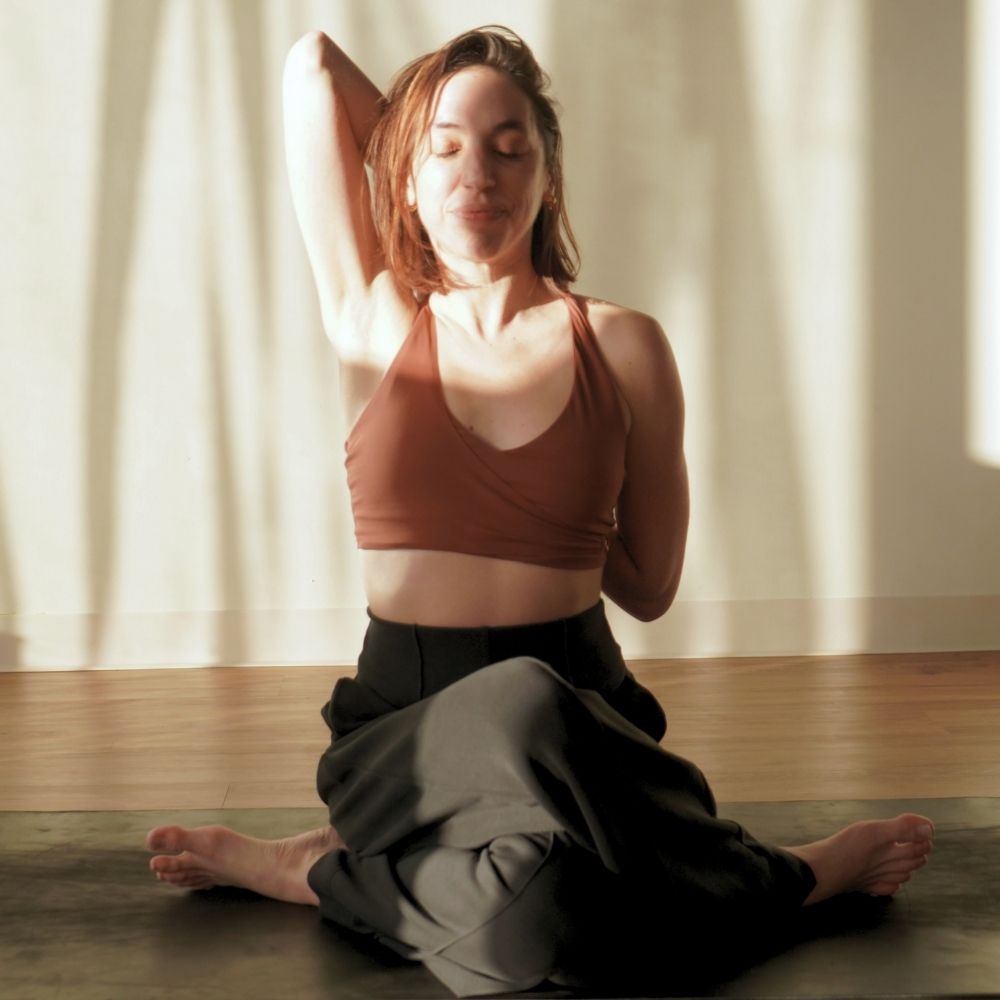
My yoga teacher training was where I started to learn about the way trauma disrupts our connection to our bodies. If we’re disconnected from our bodies, it’s really difficult to connect with each other.
Before this, I was very much “heady”, super academic, sounding smart and sharp, but often completely disconnected from my body. I wasn’t really living my life or feeling my feelings. That’s something I see often in my work now.
The second turning point was reaching the end of a yoga class and finally experiencing a quiet mind, a rarity for me, or lying in savasana and starting to cry out of nowhere, having had no idea I had even been feeling sad.
It was because I had stopped thinking, and processing, and analyzing, and had started feeling. That was the beginning of me thinking: maybe it’s not enough to just talk about our feelings. Maybe we need to move them through.
Services I offer
Clinical therapy and coaching.
I offer both, depending on where you live, and where you’re at one or both may make sense.
NEW-YORK STATE ONLY – online
Online ERP Therapy for OCD
Evidence-based treatment for intrusive thoughts, mental compulsions, and the parts of OCD most people never see.
lisbon & worldwide – online
ADHD & Neurodivergent Coaching
Clinically-informed, neurodivergent-affirming coaching for burnout, overwhelm, and the “million ideas, no idea where to start” seasons.
Consulting services
Consulting – Social entrepreneurs
Business Consulting for Health Startups
For social entrepreneurs and organizations building businesses that prioritize human wellbeing. I bring 14 years of social work experience to an initial analysis of your product or idea.
Exploratory – One session or more
Bridging & Brainstorming
Not sure where to start your healing or professional journey? I’ll have an assessment session with you, then connect you to my curated network of somatic practitioners, dancers, and healers.
Creative coaching
Creativity Coaching
Get clear on your vision, unblock your creativity, and bring your ideas to life. CVs, website copy, articles that you’ve had in your head for years but never published.
My approach
Awareness. Acceptance. Action.
I did not come up with these, they’re called the “3 As”, but they’re what I see as the process of change. A lot of us try to skip from awareness right into action.
Awareness is uncomfortable, and action feels like a release from whatever we’re feeling and realizing. The issue is: if we take action without first integrating our realizations, it doesn’t always produce the results we’re looking for.
That integration stage, the acceptance, the forgiveness of self, the compassion, that’s where I really see people start to shift.
That, honestly, is the arc of the work. The only thing that changes from person to person is the timeline, and the only promise I can make is that if you keep at it, things will begin to shift.
My approach
Collaboration
I have some expertise, some skills, but ultimately you are the expert on you. Therapy is teamwork, we take turns leading and following.
Empathy & respect
As few assumptions as possible. Patience, warmth, making space. Empowering, and not enabling.
Deep care & deep listening
An energy I try to bring into the therapeutic space: a sense that you are safe and heard and held.
How I work
A wide-lens view, then specific.
I think I stand out because I have a wide range of experiences. In my life, I can sometimes exhaust myself because I think about things from every possible angle, but in the therapy space, this is my gift. I can’t see everything, but I try to view the work from as wide a lens as possible, not leaving any stone unturned. Then we work our way in, getting more specific as we go, making as few assumptions as possible.
Modalities I draw from
- Exposure and Response Prevention (ERP)
- Somatic healing practices
- Yoga and mind–body work
- Cognitive Behavioral Therapy (CBT)
- Motivational Interviewing
Who I work with
The people I do my best work with.
The people I do my best work with tend to be intelligent, highly motivated, creative, multi-hyphenate humans, with a million ideas, who are coming to me because they feel burned out, scattered, or are having a hard time figuring out what’s next for them.
I am neurodiverse-affirming and trauma-informed. If you are somewhere on the neurodiverse umbrella, working with the effects of trauma, or navigating both, you’re welcome here.
When I refer out: if I’m working with someone in a coaching context and sense they’d benefit from additional therapeutic support, I’ll make a referral. In a therapy context, I provide outpatient telehealth — one of the lowest levels of care available. If someone needs a more intensive level of care, or would benefit from a psychiatrist and medication management, I’ll refer.
Why I do this work
What keeps me in it.
I have tried to leave this work so many times. But whatever you believe in is just like, “nope, sorry, this is your calling.” The work itself is so gorgeous and rewarding. But basically everything around it is really tough: the systems, the lack of support for therapists and caregivers, the list goes on.
So in this season of my life, I’m looking for a way to do this work sustainably — and to perhaps create environments for others to do it sustainably as well. Because I really feel that if you take care of the people who are taking care of the people, you take care of everyone.
What keeps me in it is a sense that something bigger than me is happening. That there is a collective call to healing happening right now. And it might sound corny, but it’s always darkest before the dawn — and before any kind of breakthrough. So I try to hold onto that on the days when it feels dark. Because it feels like we’re on the precipice of something.
A poem that captures how I think about this work
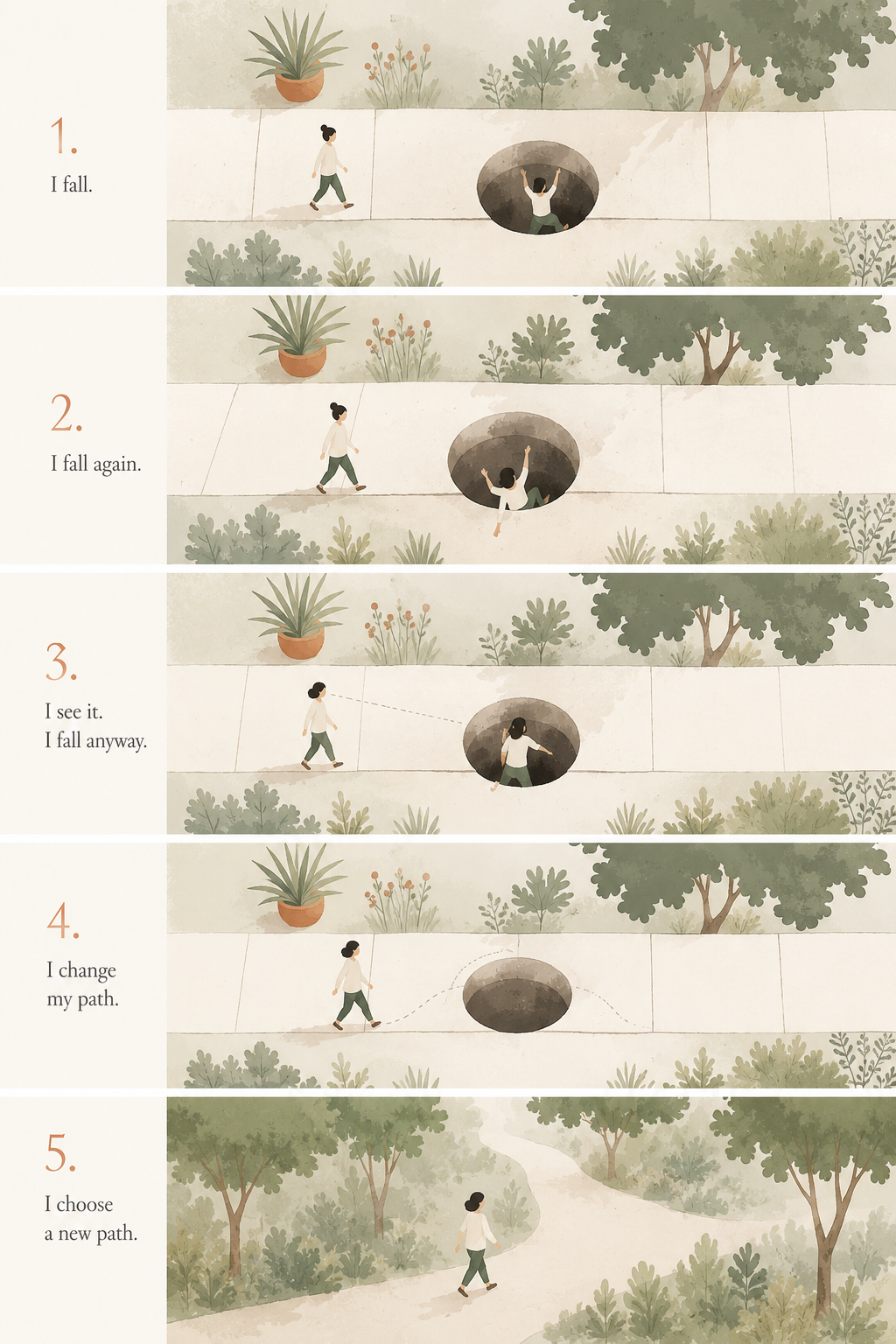
1. I walk down the street.
There is a deep hole in the sidewalk. I fall in. I am lost… I am hopeless. It isn’t my fault. It takes forever to find a way out. I.
2. I walk down the same street.
There is a deep hole in the sidewalk. I pretend I don’t see it. I fall in again. I can’t believe I’m in the same place. But it isn’t my fault. It still takes a long time to get out. II.
3. I walk down the same street.
There is a deep hole in the sidewalk. I see it is there. I still fall in… it’s a habit. My eyes are open. I know where I am. It is my fault. I get out immediately. III.
4. I walk down the same street.
There is a deep hole in the sidewalk. I walk around it
5. I walk down another street.
— Autobiography in Five Chapters, Portia Nelson
Questions
Questions about working together.
What a session looks like?
The only “typical” sessions I can describe are the ones at the start of working together, more focused on information gathering, a little more formal, getting a history and a sense of what’s been going on. As the work evolves, so do the sessions.
What is your therapy style?
Collaborative, somatic, and trauma-informed. I draw from ERP, CBT, motivational interviewing, and mind–body practices from my yoga training. I view every session as a dance: testing the waters, moving forward when it’s time, pulling back when a reprieve is needed. Deep listening, few expectations.
How do you decide which approach to use?
honestly? Vibes. I know that isn’t a scientific answer, but it’s mine. I view every session like a dance, testing the waters, moving forward when it feels like time, pulling back when a reprieve is needed. Deep listening, few to no expectations.
What can I expect from working with you?
The early sessions are more structured: history-gathering, getting a sense of what’s been going on for you. As the work evolves, so do the sessions. There’s always a framework and a goal, but the path to get there changes week to week.
How long does care typically take?
That’s the hardest question to answer honestly, because it varies so much from person to person. What I can say is: if you keep at it, things will begin to shift.
Ready to see if we’re a fit?
Let’s have a conversation.
The first step is a free 30-minute discovery call, just a conversation to see if what I offer matches what you’re looking for.